
Manuka Oil vs Tea Tree Oil: Antibacterial, Antifungal and Anti-Inflammatory Properties Explained
Tea tree oil has been a familiar ingredient in natural skincare for decades. But another botanical essential oil from New Zealand has attracted growing scientific interest: Manuka oil.
Both oils belong to the myrtle family, yet their chemical compositions are distinctly different.
Research has explored Mānuka oil's antibacterial, antifungal and anti-inflammatory properties, with laboratory studies identifying promising activity against particular microorganisms.
So what makes Manuka oil different from tea tree oil, and what does the science actually tell us?
What Is Manuka Oil?
Manuka oil is an essential oil obtained from Leptospermum scoparium, a flowering shrub native to New Zealand and Australia.
Unlike Manuka honey, which bees produce from floral nectar, Manuka essential oil is typically extracted through steam distillation of the plant's leaves and young stems.
The resulting oil contains naturally occurring botanical compounds, including sesquiterpenes and, in some varieties, beta-triketones.
These beta-triketones, including leptospermone, flavesone and isoleptospermone, have attracted particular scientific interest because of their antimicrobial activity.
However, not all Mānuka oils have identical chemical compositions. Geographic origin, plant genetics, harvesting conditions and processing can influence the compounds present.

What Is Tea Tree Oil?
Tea tree oil is derived primarily from Melaleuca alternifolia, a plant native to Australia.
It is widely used in personal care products and has been extensively investigated for antimicrobial activity.
Its chemical profile is typically characterised by terpinen-4-ol, a compound associated with several of its biological properties.
Although tea tree oil and Manuka oil belong to the same botanical family, they are not interchangeable.
Their different chemical compositions can produce different results in laboratory testing.
Mānuka Oil vs Tea Tree Oil: What's the Difference?
Although Mānuka oil and tea tree oil belong to the same botanical family, their chemical compositions differ, influencing how they behave in scientific studies.
Both have demonstrated antibacterial, antifungal and anti-inflammatory activity, but their naturally occurring compounds give each oil distinctive properties.
|
Feature |
Mānuka Oil |
Tea Tree Oil |
|---|---|---|
|
Where it comes from |
Mānuka plant, associated particularly with New Zealand |
Australian tea tree plant |
|
Key natural compounds |
Beta-triketones in certain varieties |
Terpinen-4-ol |
|
Antibacterial properties |
Activity against certain bacteria, including Staphylococcus aureus, in laboratory studies |
Activity against a range of bacteria in laboratory studies |
|
Antifungal properties |
Activity against dermatophytes associated with fungal skin and nail infections in laboratory studies |
Activity against several fungal species in laboratory studies |
|
Anti-inflammatory properties |
Demonstrated effects on inflammatory signalling in laboratory studies |
Demonstrated anti-inflammatory activity in laboratory studies |
So, is Mānuka oil better than tea tree oil?
Both oils have distinctive properties, but research has identified some interesting differences.
Certain Mānuka oil samples have demonstrated particularly strong antifungal activity against dermatophytes - the fungi associated with conditions such as athlete's foot and fungal nail infections - under laboratory conditions.
Mānuka oil's unique chemical composition, particularly its naturally occurring beta-triketones, has also attracted scientific interest for its antibacterial and antifungal properties.
The effectiveness of either oil depends on its chemical composition, concentration and intended application.
These findings help explain the growing scientific interest in Mānuka oil and its botanical properties.
1. Manuka Oil's Antibacterial Properties
One of the most extensively investigated characteristics of Manuka oil is its antibacterial activity.
Laboratory studies have demonstrated that certain Manuka oil samples can inhibit the growth of bacteria, including Staphylococcus aureus.
A study by Christoph and colleagues, published in Planta Medica in 2000, compared the antimicrobial properties of several essential oils, including Manuka oil and Australian tea tree oil.
Researchers reported that Manuka oil produced particularly strong inhibitory effects against certain Gram-positive bacteria in their laboratory tests.
The activity was associated with naturally occurring beta-triketones.
These findings help explain why Manuka oil continues to attract interest in botanical antimicrobial research.
Importantly, antibacterial activity observed in laboratory experiments does not automatically establish effectiveness in preventing or treating bacterial infections in people.
2. Manuka Oil's Antifungal Properties
Manuka oil has also demonstrated antifungal activity in scientific investigations.
This is particularly interesting because fungi are responsible for a range of common skin and nail conditions.
The 2000 study by Christoph and colleagues reported strong laboratory inhibitory effects against dermatophytes - fungi that can be associated with athlete's foot, ringworm and fungal nail infections.
Additional research by Chen and colleagues examined Manuka and Kanuka essential oils against several fungal species, including Candida albicans and Malassezia furfur.
The researchers observed antifungal activity under controlled laboratory conditions.
What About Manuka Oil and Toenail Fungus?
Toenail fungus, medically known as onychomycosis, is commonly associated with dermatophytes.
Because Manuka oil has demonstrated activity against certain dermatophytes in laboratory studies, its antifungal properties are an interesting area of botanical research.
However, fungal nail infections can be difficult to manage because fungi may grow beneath or within the nail.
For a more detailed explanation, read our article Toenail Fungus and Manuka Oil.
3. Manuka Oil's Anti-Inflammatory Properties
Inflammation is part of the body's natural response to irritation, injury and infection.
Researchers have investigated whether compounds in Manuka oil can influence inflammatory processes.
A study by Chen and colleagues examined the effects of Manuka and Kanuka oils on cultured human immune cells.
The researchers found that both oils reduced the release of tumour necrosis factor-alpha (TNF-α), a signalling molecule involved in inflammatory responses, under the experimental conditions.
A comprehensive scientific review published in Pharmaceuticals in 2020 also examined research into Manuka oil's anti-inflammatory properties.
These findings provide a scientific basis for continued investigation into the oil's biological activity.
Why Are Beta-Triketones Important?
One of the distinguishing features of some New Zealand Manuka oils is their beta-triketone content.
Beta-triketones are naturally occurring compounds that contribute to the chemical profile of certain Manuka oil varieties.
Research has associated these compounds with antibacterial and antifungal activity.
This is one reason why the origin and chemical composition of Manuka oil matter.
Two products labelled Manuka oil may have different concentrations of these compounds, and therefore may not perform identically in laboratory tests.
Botanical identity, geographic provenance and quality testing are important considerations when evaluating essential oils.
Is Manuka Oil Better Than Tea Tree Oil?
It depends on what is being compared.
In some laboratory experiments, Manuka oil has demonstrated stronger inhibitory effects against particular microorganisms, including certain dermatophytes and Gram-positive bacteria.
Both have distinctive chemical profiles and scientifically investigated properties.
Tea tree oil and Manuka oil both have a large ever growing body of human clinical research, while much of the evidence concerning Manuka oil remains laboratory-based.

Can Manuka Oil Irritate Sensitive Skin?
Like other essential oils, Manuka oil is highly concentrated.
Natural ingredients are not automatically suitable for every skin type.
Always follow the specific product's directions, including any dilution and patch-testing recommendations.
Discover Manuka Biotic Certified Organic Manuka Oil
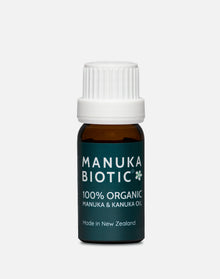
At Manuka Biotic, we celebrate being the worlds first producers of certified Organic Manuka and Kanuka oil.
Our 10 ml Certified Organic Manuka Oil contains Manuka and Kanuka oils, with BioGro organic certification and wild-harvested botanical ingredients.
Explore our Certified Organic Manuka Oil to learn more about its ingredients, origin and recommended use.
The scientific research discussed in this article concerns botanical essential oils and does not establish that Manuka Biotic's product treats fungal infections, bacterial infections or inflammatory conditions.

Frequently Asked Questions
Is Manuka oil antibacterial?
Laboratory research has demonstrated antibacterial activity in Manuka oil samples, including inhibitory effects against particular Gram-positive bacteria.
Is Manuka oil antifungal?
Yes, antifungal activity has been demonstrated under laboratory conditions. Studies have reported inhibition of certain dermatophytes and other fungal species.
Does Manuka oil have anti-inflammatory properties?
Laboratory and cellular research has identified anti-inflammatory activity, including effects on inflammatory signalling molecules.
Can Manuka oil treat toenail fungus?
There is evidence to establish that Manuka oil can safely and effectively treats toenail fungus. Persistent nail changes should be assessed by a healthcare professional.
Is Manuka oil stronger than tea tree oil?
Not universally. Their relative antimicrobial activity depends on the organisms tested, oil composition, concentration and experimental conditions.
Is Manuka oil the same as Manuka honey?
No. Manuka oil is distilled from plant material, while Manuka honey is produced by bees collecting nectar from Manuka flowers. They have different compositions and should not be considered interchangeable.
Can Manuka oil be used on sensitive skin?
Essential oils can cause irritation or allergic reactions. Follow the product's safety directions, including appropriate dilution and patch testing.
Scientific Research and Further Reading
1. Christoph, F., Kaulfers, P.-M. & Stahl-Biskup, E. (2000).
A Comparative Study of the in vitro Antimicrobial Activity of Tea Tree Oils s.l. with Special Reference to the Activity of β-Triketones.
Planta Medica, 66(6), 556–560.
2. Chen, C.-C. et al. (2016).
Investigations of Kanuka and Manuka Essential Oils for in vitro Treatment of Disease and Cellular Inflammation Caused by Infectious Microorganisms.
Journal of Microbiology, Immunology and Infection, 49(1), 104–111.
3. Mathew, C. et al. (2020).
Mānuka Oil-A Review of Antimicrobial and Other Medicinal Properties.
Pharmaceuticals, 13(11), 343.
Read the full scientific review
4. Lis-Balchin, M., Hart, S. L. & Deans, S. G. (2000).
Pharmacological and Antimicrobial Studies on Different Tea-Tree Oils (Melaleuca alternifolia, Leptospermum scoparium or Manuka and Kunzea ericoides or Kanuka), Originating in Australia and New Zealand.
Phytotherapy Research, 14(8), 623–629.
This article provides educational information about botanical ingredients and published research. Laboratory results do not establish the safety or effectiveness of Manuka Biotic products for treating medical conditions.